

Let me paint you a picture. It’s Tuesday morning, the storm wrapped up the night before, and you step outside with your coffee — only to find your backyard looking like a small lake. Sound familiar? Yeah, I’ve been there too.
Water runoff is one of the sneakiest, most frustrating problems a homeowner can face. Left unchecked, it erodes soil, drowns plants, floods basements, and quietly chips away at your home’s foundation. The good news? With the right water runoff landscaping strategies, you can turn that soggy mess into a yard that’s actually smarter than the storm.
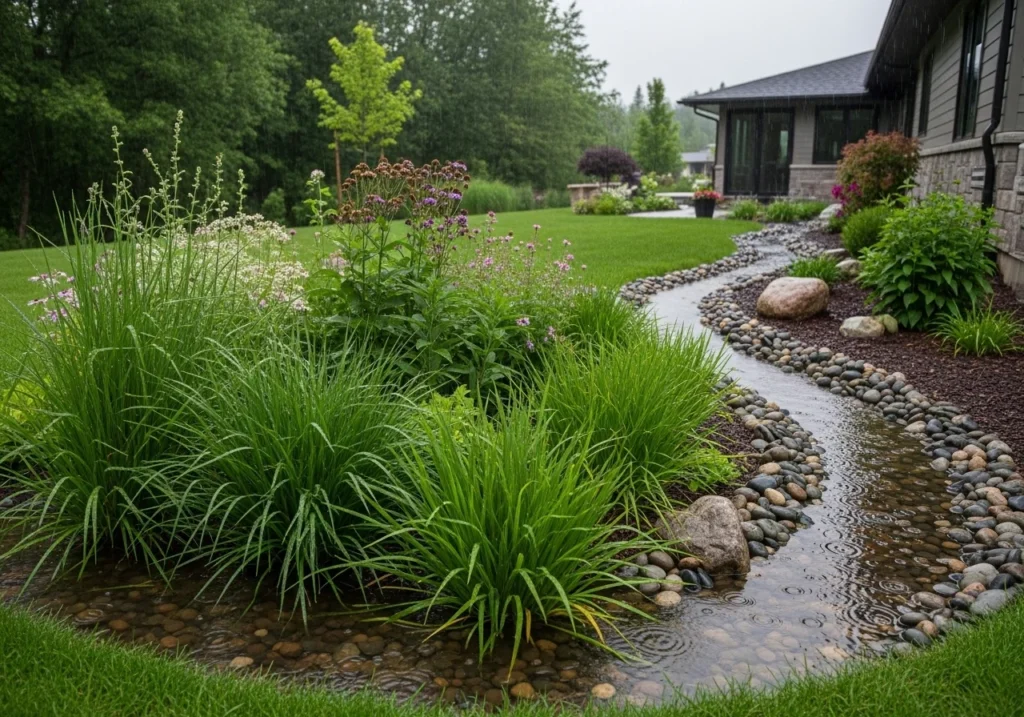
Whether your yard slopes toward your house, you have clay-heavy soil that refuses to drain, or your downspouts shoot water straight at your flower beds — this guide covers 12 real, proven yard drainage solutions that work in the USA’s wildly varied climates and soil types.
Quick stat: According to the EPA, stormwater runoff is one of the leading sources of water pollution in the U.S. Managing it at home isn’t just about your yard — it’s genuinely good for your watershed.
Table of Contents
First, What Is Water Runoff Landscaping — and Why Does It Matter?
Water runoff landscaping refers to designing or modifying your yard specifically to manage, redirect, absorb, or slow down the movement of rainwater across your property. It’s the whole umbrella — from grading your lawn to planting deep-rooted native grasses to installing French drains or permeable pavers.
The difference between runoff and drainage is subtle but worth knowing. Runoff is the water moving across the surface of your land. Drainage is where it ends up — gutters, drains, waterways. Good landscape drainage solutions address both: slowing runoff before it becomes someone else’s problem downstream.
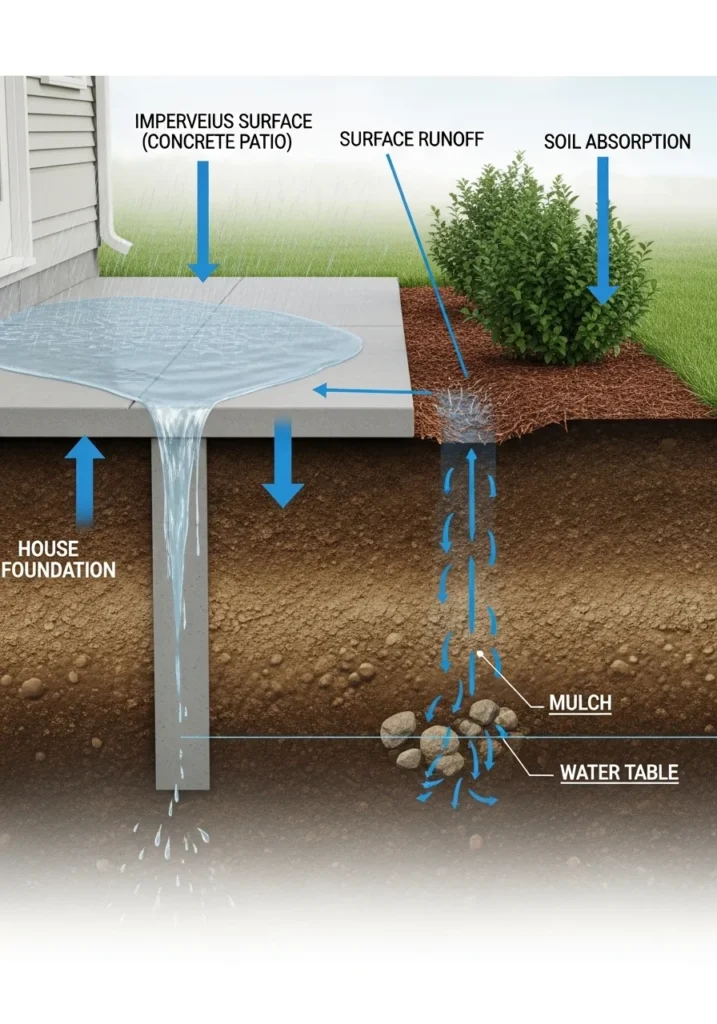
What causes runoff in a typical landscaped yard? A handful of usual suspects:
- Compacted or clay-heavy soil that water can’t penetrate fast enough
- Slopes that grade toward the house instead of away
- Too much hard surface — driveways, patios, concrete walkways
- Disconnected downspouts that dump water right at your foundation
- Lack of vegetation to slow, absorb, and transpire rainwater
Read More:
- Vertical Gardening for Beginners: Your Complete Guide to Growing Up (Literally)
- Zinnia garden ideas: why zinnias deserve a spot in every yard
- Cheap Fence Ideas on a Budget: 15 Affordable Options That Actually Look Good (2026)
12 Landscaping Solutions for Water Runoff That Actually Work
1 Grade Your Yard Away From the House
This is the foundation of all drainage landscaping — literally. Your yard should slope away from your house at roughly 6 inches over the first 10 feet. If it doesn’t, water pools against your foundation, and that’s how basements get wet and slab cracks form. Regrading is a bigger project, but it’s the one fix that underlies everything else. Think of it as resetting the table before you serve the meal.
Protects your foundation from runoff?
Absolutely — this is step one.
2 Build a Rain Garden
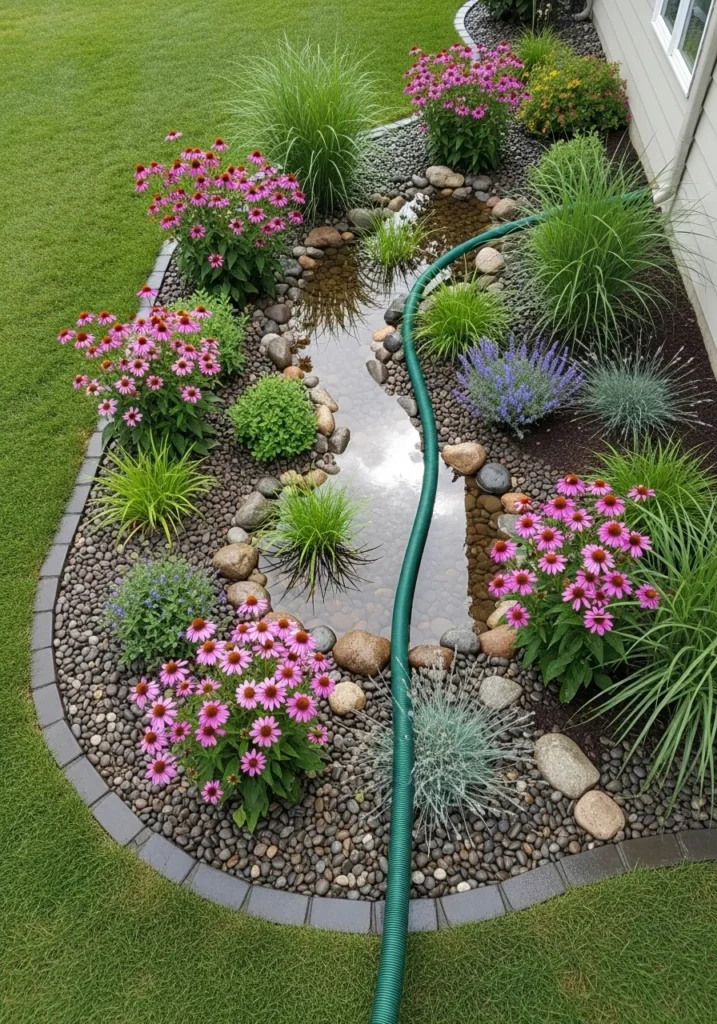
Rain gardens are shallow, planted depressions that capture runoff from rooftops, driveways, and lawns. Water flows in, sits for a while, and soaks into the ground naturally. They’re beautiful, they support pollinators, and they can reduce runoff by up to 30% compared to a traditional lawn.
How far should a rain garden be from the house?
At least
10 feet
— ideally 15–20 feet — to keep water from seeping toward your foundation. You want it close enough to receive downspout flow, but not so close it works against you.
3 Install a Swale
A swale is a shallow channel — often gently sloped and planted with grass or native plants — that guides water away from problem areas at a controlled pace. Think of it as a slow-motion stream you designed. Swale landscaping can be subtle and gorgeous when done right, lined with ornamental grasses, river rock, or flowering perennials.
The difference between a swale and a ditch: a swale is intended to hold and filter water. A ditch just moves it. Bioswales (swales with engineered planting and sometimes gravel layers) go further by actively treating stormwater as it moves through.
4 Dig a French Drain
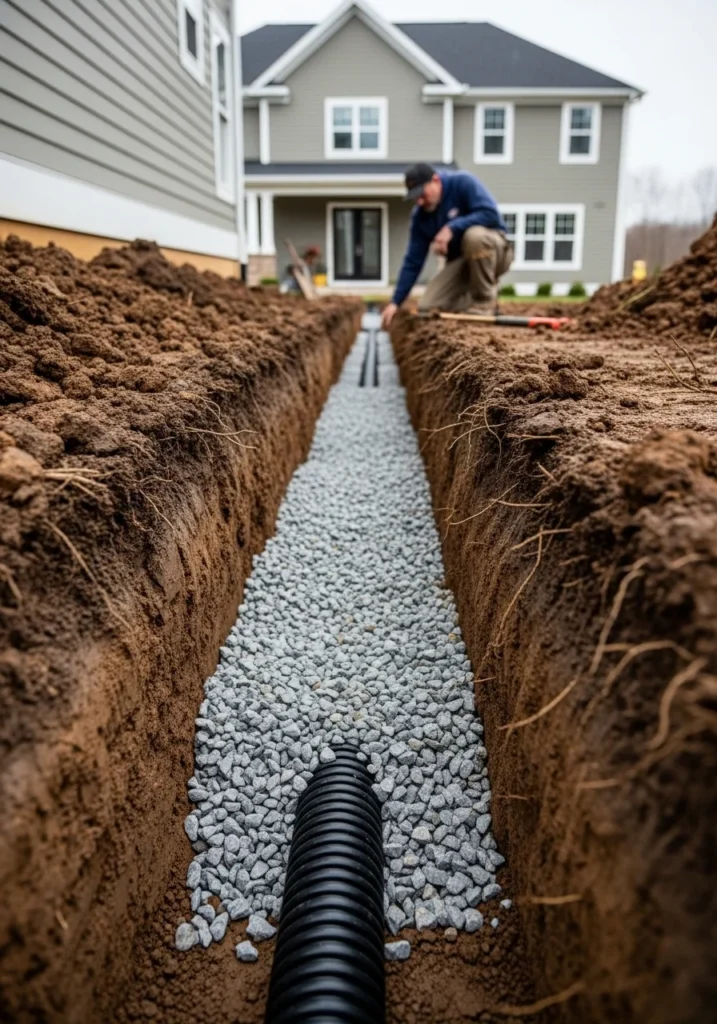
If your yard has a persistently wet zone — a corner that never dries out, a low spot that floods — a French drain might be your best friend. It’s a trench filled with gravel and a perforated pipe that collects underground water and routes it somewhere useful, like a dry well, a rain garden, or the street.
French drain landscaping is especially effective when surface-level fixes just can’t keep up. It works under the problem. Installation can be DIY with a rented trencher, but a pro can make sure the pitch and outlet are right.
5 Use Permeable Pavers
Traditional concrete and asphalt are basically water slides for runoff.
Permeable pavers
have gaps or porous material that let water soak through into a gravel bed below, then slowly into the soil. They look fantastic in driveways, patios, and walkways, and they can dramatically reduce the hard-surface contribution to your stormwater problem.
Do they reduce runoff? Research consistently says yes — permeable surfaces can absorb 80–100% of light-to-moderate rainfall that would otherwise sheet off into the storm drain.
6 Add Deep-Rooted Native Plants
This one’s a slow burn, but incredibly powerful. Native plants — grasses, wildflowers, shrubs suited to your region — develop root systems that can go 12 feet deep or more, creating channels for water to enter the soil fast. Prairie dropseed, native sedges, black-eyed Susans, coneflowers: the best plants for runoff control are ones that belong where they’re planted.
Compared to turf grass (shallow roots, compaction-prone), a native planting bed can absorb significantly more water per square foot. It’s also dramatically lower maintenance once established. Win-win-win.
7 Spread Mulch Generously
Can mulch reduce runoff? Yes — and it’s the most underrated tool in the shed. A 2–3 inch layer of organic mulch (wood chips, shredded bark, straw) slows water velocity so it has time to absorb rather than sheet off. It also prevents soil from crusting over after rain, which is a major cause of compaction-driven runoff.
Keep mulch a few inches away from plant stems and trunks to prevent rot. And replenish it annually — it breaks down, which actually improves your soil over time. A genuinely useful cycle.
8 Redirect Your Downspouts
It’s almost silly how much of a difference this makes. If your downspouts dump water right against the foundation or onto a slope that faces the house — that’s the single most common cause of foundation and basement moisture problems.
Solutions range from simple (extend the downspout with a splash block or flexible pipe, aiming it 6–10 feet away from the house) to elegant (direct it into a rain barrel, a rain garden, or an underground pipe system). Downspout drainage is one of the fastest, cheapest fixes on this entire list.
9 Install a Dry Creek Bed
This is where stormwater management gets genuinely beautiful. A dry creek bed is a decorative channel lined with river rock and boulders that moves water during heavy rain and looks like a natural feature the rest of the time. It follows the natural slope of your yard — which is exactly where water wants to go anyway — and guides it to a safe destination.
The rocks slow water velocity, filter sediment, and prevent erosion. You can plant ornamental grasses, ferns, or native shrubs along the edges to soften the look and boost absorption.
10 Build Terraces on Slopes
Got a hill in your yard? Water is going to run straight down it, picking up speed and soil as it goes. Terracing — creating level steps across a slope, each held back by a retaining wall of stone, timber, or concrete — breaks that flow into manageable segments. Each flat terrace gives water time to soak in before overflowing to the next level.
Terraces are especially effective for slope drainage landscaping and make a dramatic visual feature out of what could otherwise be an erosion-prone slope.
11 Try a Bioswale
Are bioswales good for residential landscaping? Genuinely, yes — especially in urban or suburban lots where impervious surface coverage is high. A bioswale is essentially a swale with a designed growing medium (often sandy loam or amended soil) and specific plant selection for maximum infiltration and pollutant removal.
They’re common in commercial developments, but there’s no reason they can’t work beautifully in a home garden. Paired with native plants and river rock borders, a well-designed bioswale is as much a garden feature as a drainage solution.
12 Install a Rain Barrel or Cistern
Capturing runoff before it even hits the ground is the most elegant solution of all. A rain barrel at each downspout collects water you can then use for irrigation during dry spells — turning a problem into a resource. Larger cisterns (underground or above-ground) can hold hundreds or thousands of gallons for serious rainwater harvesting.
It’s one of the most sustainable stormwater landscaping strategies available to homeowners, and many states offer rebates for rain barrel programs.
Quick Comparison: Which Solution Is Right for You?
| Solution | DIY-Friendly | Best For | Cost Range | Visual Appeal |
|---|---|---|---|---|
| Regrading | ✗ (hire a pro) | Foundation protection | $$$ | Neutral |
| Rain Garden | ✓ | Downspout redirecting | $–$$ | High |
| Swale | ✓ | Slope drainage | $–$$ | Moderate–High |
| French Drain | Moderate | Persistent wet zones | $$–$$$ | Hidden |
| Permeable Pavers | ✗ (labor-intensive) | Driveways, patios | $$$ | High |
| Native Plants | ✓ | Long-term soil health | $–$$ | High |
| Mulch | ✓ | Everywhere | $ | Moderate |
| Downspout Extension | ✓ | Foundation safety | $ | Low |
| Dry Creek Bed | ✓ | Decorative drainage | $$ | Very High |
| Terracing | Moderate | Sloped yards | $$–$$$ | High |
| Bioswale | Moderate | Urban/suburban lots | $$ | High |
| Rain Barrel | ✓ | Conservation + control | $ | Moderate |
“The most effective stormwater management happens as close to the source as possible — on your own property, before water reaches the curb. Every lawn, every garden bed, every roof has a role to play.”— American Society of Landscape Architects (ASLA), Sustainable Landscapes Guidelines
Frequently Asked Questions About Water Runoff Landscaping
What is the best landscaping for drainage problems?
There isn’t a single ‘best’ landscaping fix for drainage; the ideal solution depends entirely on your landscape’s layout. While rain gardens and French drains are perfect for soggy, flat ground, slopes are better managed with terracing and swales. To protect your foundation, start with regrading and downspout redirection. Ultimately, resolving complex runoff issues usually requires a strategic combination of these methods layered together.
Should I grade my yard to fix drainage?
If water flows toward your house rather than away, grading is almost certainly necessary. It’s a foundational fix. Other solutions help, but if the slope is wrong, you’re working against gravity every time it rains.
What is the difference between runoff and drainage?
Runoff is water moving across the surface of your land. Drainage is the system — gutters, pipes, soil percolation — that removes water from your yard. Good yard drainage solutions address both: slowing and capturing runoff before it overwhelms the drainage system.
What plants work best for runoff control?
Deep-rooted natives are the champions: switchgrass, prairie dropseed, native sedges, coneflowers, black-eyed Susan, Joe-Pye weed, and native shrubs like buttonbush or red-twig dogwood. The deeper the roots, the more water the plant system can absorb and transpire.
Can permeable pavers reduce water runoff?
Yes — significantly. Permeable pavers allow water to infiltrate rather than sheet off, reducing surface runoff from driveways and patios by up to 80–100% in moderate rain events. They’re one of the most effective permeable landscaping strategies available to homeowners.
How do I protect my foundation from runoff?
Three priorities: (1) Grade the soil to slope away from the house, (2) extend downspouts at least 6 feet from the foundation, and (3) ensure any rain garden is at least 10 feet away. Together, these three steps eliminate the majority of foundation-moisture problems caused by stormwater.
The Bottom Line: Work With Water, Not Against It
Here’s the thing about water runoff — it’s not really an enemy. It’s just water doing what physics tells it to do. Your job as a homeowner or gardener is to slow it down, spread it out, and give it a better place to go.
Start with the low-hanging fruit: extend your downspouts, spread mulch in your planting beds, and check which direction your soil is graded. Those three moves alone can meaningfully reduce runoff in a single afternoon. From there, consider adding a rain garden, a dry creek bed, or native plantings to build a yard that’s genuinely resilient — one that looks better, drains better, and actually helps your local water cycle rather than contributing to the problem.
The yard you fix today is the one that won’t flood your neighbor’s basement tomorrow. That’s a pretty good reason to dig in.
Ready to Fix Your Yard’s Runoff Problem?
Pin this guide, save it for spring planting season, and share it with a neighbor who’s been complaining about their soggy backyard.











3 thoughts on “Water Runoff Landscaping: 12 Smart Solutions to Stop the Flood in Your Yard”