

Let me paint you a picture. You’ve got a sloped backyard that’s basically a mudslide waiting to happen every spring. Grass won’t hold, mulch washes away, and you’re tired of watching your garden slowly disappear downhill. Sound familiar?
Here’s what I’d tell you: a natural rock retaining wall might just be the most beautiful, hardworking thing you ever add to your landscape.
There’s something deeply satisfying about stacked stone. It’s ancient — humans have been piling rocks into walls for thousands of years — and yet it never looks dated. Whether you’re dealing with a steep hillside, a terraced garden, or just a gentle slope that needs some definition, a natural stone retaining wall does double duty: it holds the earth back and makes your yard look like a spread from a design magazine.
In this guide, I’m going to walk you through everything — from choosing the right stones to drainage, base depth, costs, permits, and the plants that make a rock wall sing. Let’s dig in.
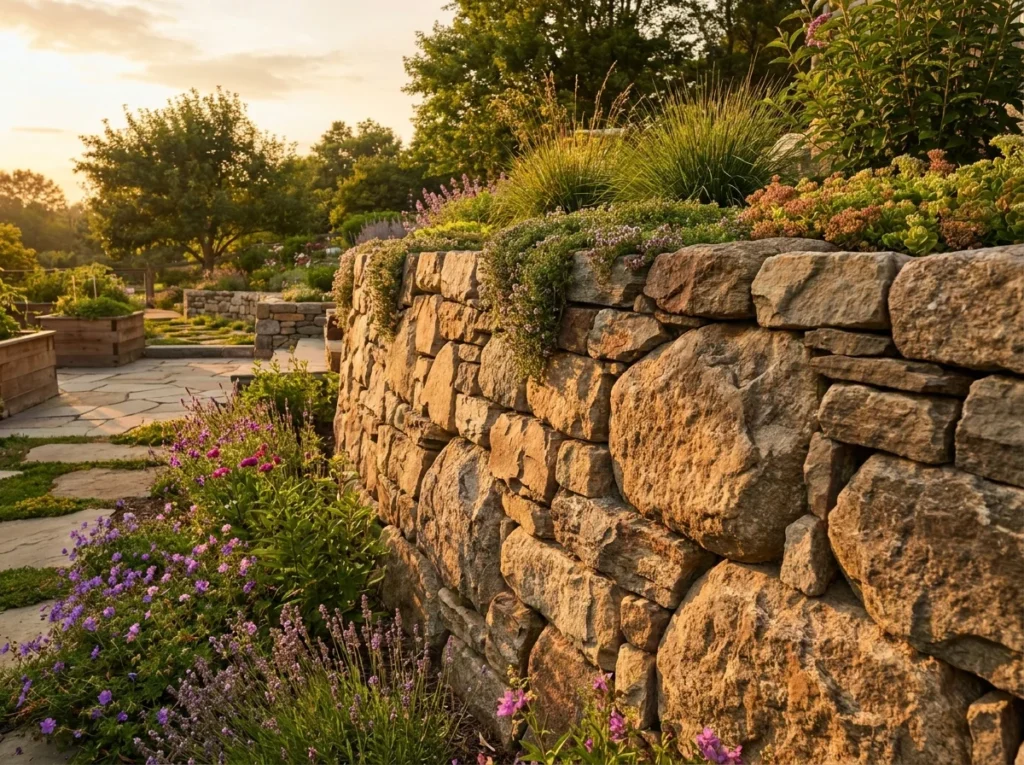
Table of Contents
1. What Exactly Is a Natural Rock Retaining Wall?
So, what even is a natural rock retaining wall? Simply put, it’s a structure built from unprocessed or minimally processed stone — think fieldstone, granite boulders, limestone slabs, or sandstone — designed to hold back soil on a slope or elevation change.
Unlike poured concrete or engineered block walls, a natural stone retaining wall works with the landscape. It breathes. It settles. It develops character over time. And because each stone is unique, no two walls ever look the same.
There are two main construction styles:
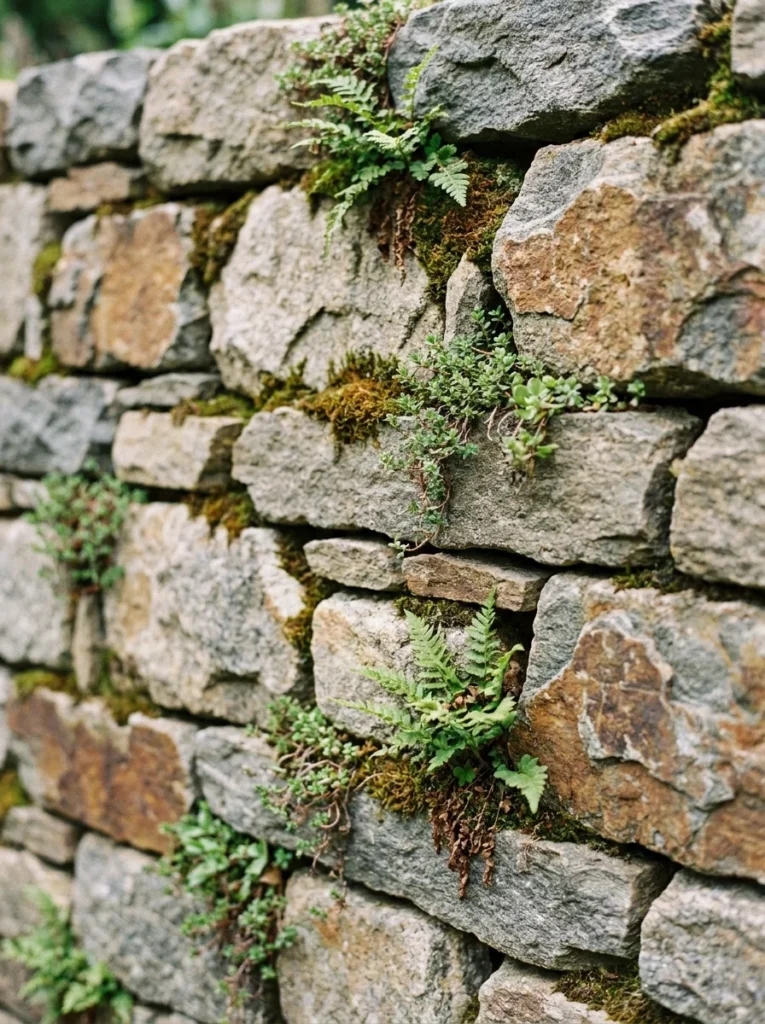
- Dry-stack (dry stone) retaining wall — stones are stacked and interlocked without mortar. The weight and friction of the stones hold everything together. This is the classic, organic look.
- Mortared stone wall — stones are set with cement mortar for extra stability. Better for taller walls or areas with heavy soil pressure.
For most residential landscaping, dry-stack is the go-to. It’s forgiving, drains naturally, and honestly? It looks more beautiful.
2. What Stones Are Best for a Retaining Wall?
Not all rocks are created equal. Here’s a quick breakdown of the best options for retaining wall stones:
–$
| Stone Type | Best For | Durability | Cost Range |
|---|---|---|---|
| Fieldstone | Rustic, natural look | Very high | $$ |
| Granite boulders | Large boulder walls | Extremely high | $$$ |
| Limestone | Formal or casual walls | High | $$ |
| Sandstone | Warm, earthy aesthetic | Moderate | –$ |
| Flagstone | Flat-faced, tidy look | High | |
| Basalt | Modern, dark look | Very high | $$$ |
My personal pick? Fieldstone or granite. Fieldstone gives you that timeless, organic feel — it looks like it’s been on your property forever. Granite is nearly indestructible, which matters if you’re building a hillside retaining wall with serious soil pressure behind it.
Avoid soft sandstone in freeze-thaw climates (hello, Northeast and Midwest) — it can crack and crumble over time. And skip shale. Just skip it entirely.
3. How Do You Build a Natural Rock Retaining Wall? (Step-by-Step)
Okay, roll up your sleeves. Here’s how it’s done.
Step 1: Plan and Mark Your Layout
Walk the slope. Figure out the height you need and where the wall will run. For anything over 4 feet tall, I’d strongly recommend hiring a professional — and check local permit requirements first (more on that below).
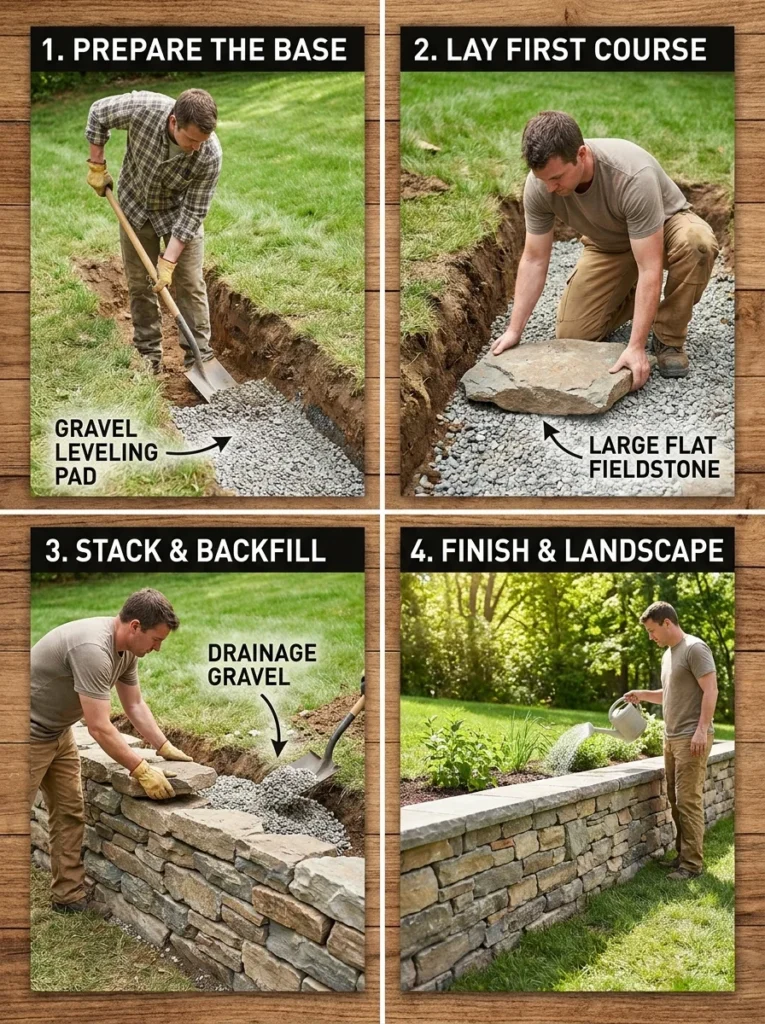
Step 2: Excavate and Prepare the Base
Dig a trench at least 6–12 inches deep for a small wall (under 3 feet). For taller walls, go deeper — up to 1 foot of buried base per 3 feet of finished height. Level the bottom of the trench.
How deep should the base be for a rock retaining wall? A good rule of thumb: bury about 10–15% of the total wall height below grade. So a 3-foot wall needs roughly 4–6 inches of base buried underground.
Step 3: Add Gravel Base Drainage
This is non-negotiable. Pour 4–6 inches of crushed stone or gravel (¾-inch clean gravel or crushed granite works great) into the trench. Compact it. This is your drainage foundation — it keeps water from pooling behind the wall and pushing it forward.
Step 4: Lay Your First Course
Place your largest, flattest stones first. These are your foundation stones. Set them tight against each other, level front-to-back with a slight backward batter (tilt into the hill — about 1 inch per foot of height).
Step 5: Stack, Interlock, and Backfill
Work upward, staggering joints like brickwork. Fill gaps with smaller stones. After each course, backfill behind the wall with gravel (not straight soil) — this aids drainage enormously.
Step 6: Add Capstones
Top it off with flat capstones. They hold everything together and give the wall a finished, intentional look.
4. Do Natural Rock Retaining Walls Need Drainage?
Yes. Absolutely. Non-negotiably yes.
This is the number one mistake people make — and it’s why walls fail. Water is the enemy of any retaining wall. When rain soaks into the soil behind a wall and has nowhere to go, hydrostatic pressure builds up. Eventually? The wall blows out.
Here’s how to drain it right:
- Gravel backfill: Use ¾-inch crushed gravel (not pea gravel) directly behind the wall — at least 12 inches wide
- Perforated drain pipe: For walls over 3 feet, lay a 4-inch perforated pipe at the base, sloped to drain sideways out of the wall
- Weep holes: In mortared walls, leave gaps or insert short pipes every 6–8 feet along the base course
- Dry-stack advantage: A dry-stone retaining wall naturally drains between the stones — one big reason it’s the preferred choice for garden retaining walls
What is the best gravel base for a retaining wall? Crushed stone with angular edges (like ¾” clean crushed granite or limestone) is ideal. The angular pieces lock together and drain fast. Avoid rounded pea gravel as a backfill — it shifts too much.
5. How Tall Can a Natural Stone Retaining Wall Be?
For a dry stone retaining wall, the practical maximum for a DIY build is about 3 feet. Beyond that, soil pressure becomes serious, and you need engineering knowledge and often a permit.
Professionally built natural stone walls can reach 6 feet or more — but they’ll require:
- Deeper footings
- Engineered drainage
- Possible permit (see below)
- Deadmen anchors (stones that extend back into the hillside to tie the wall to the soil)
Pro tip: If you need more height, consider a tiered retaining wall instead. Break up one tall wall into two or three shorter terraced walls with planting beds between them. It’s safer, more stable, and honestly more beautiful.
6. Is a Dry-Stone Retaining Wall Strong Enough?
People ask me this all the time and I love the question — because the answer surprises them.
Yes. A well-built dry stack retaining wall is incredibly strong. The Romans built dry-stone structures that are still standing today. The key is in the technique: proper batter (backward tilt), interlocked stones, no continuous vertical joints, and adequate drainage.
Where dry-stone fails is when it’s built with poor stone selection, no drainage, or by stacking flat layers without interlocking. That’s not a dry-stone wall — that’s a pile of rocks waiting to fall.
7. Boulder Wall vs. Stone Wall — What’s the Difference?
Great question. Here’s the short version:
| Feature | Boulder Retaining Wall | Stone Retaining Wall |
|---|---|---|
| Stone size | Large (1–3+ feet) | Small to medium |
| Installation | Requires machinery (skid steer) | Often hand-placed |
| Look | Rugged, natural, dramatic | Refined, intricate, crafted |
| Best for | Large slopes, erosion control | Garden walls, smaller grades |
| Cost | Higher (equipment rental) | Lower for DIY |
A boulder retaining wall uses massive individual rocks — sometimes just one or two courses high. They’re incredibly effective for slope retaining wall applications and erosion control on steep hillsides. A stacked stone retaining wall uses smaller stones carefully interlocked — more labor-intensive, but more visually detailed.
8. How Much Does a Natural Rock Retaining Wall Cost?
Let’s talk money. Here’s a realistic breakdown:
| Wall Type | DIY Cost (materials) | Professional Install |
|---|---|---|
| Small dry-stone wall (under 2 ft) | $200–$800 | $1,500–$4,000 |
| Medium fieldstone wall (2–4 ft) | $500–$2,000 | $4,000–$12,000 |
| Boulder retaining wall | $800–$3,000 | $8,000–$25,000+ |
Costs vary by region, stone availability, and site access. In most of the U.S., expect to pay $25–$75 per square face foot for professional installation of a natural stone wall.
Buying stone locally always helps — shipping large rocks is expensive. Check local quarries, landscape suppliers, or even Craigslist for fieldstone.
9. Do You Need a Permit for a Retaining Wall?
In most U.S. municipalities, yes — if the wall exceeds 3 to 4 feet in height, you’ll need a building permit. Some areas require permits for any retaining wall, regardless of height.
Always check with your local building department before you start. Unpermitted walls can be ordered demolished — an expensive and heartbreaking outcome after all that work.
If the wall is near a property line, drainage easement, or public utility, permits are almost certainly required.
10. How Do You Keep a Rock Retaining Wall from Shifting?
Here are the big factors that prevent shifting:
- Proper batter: Tilt the wall back into the slope — 1 inch per 1 foot of height
- Good drainage: Hydrostatic pressure is the #1 cause of wall movement
- Interlocked courses: No running vertical joints — offset every stone like brickwork
- Deadmen stones: For taller walls, bury long stones horizontally into the hillside every few courses to anchor the wall
- Solid base: Never build on soft or wet soil — always compact gravel first
- Capstones: Heavy flat caps tie the top course together
11. What Plants Work Well Around a Rock Retaining Wall?
This is where a rock wall landscaping project gets really fun. The right plants soften the stone, add color, and even strengthen the wall by holding soil.
Great choices include:
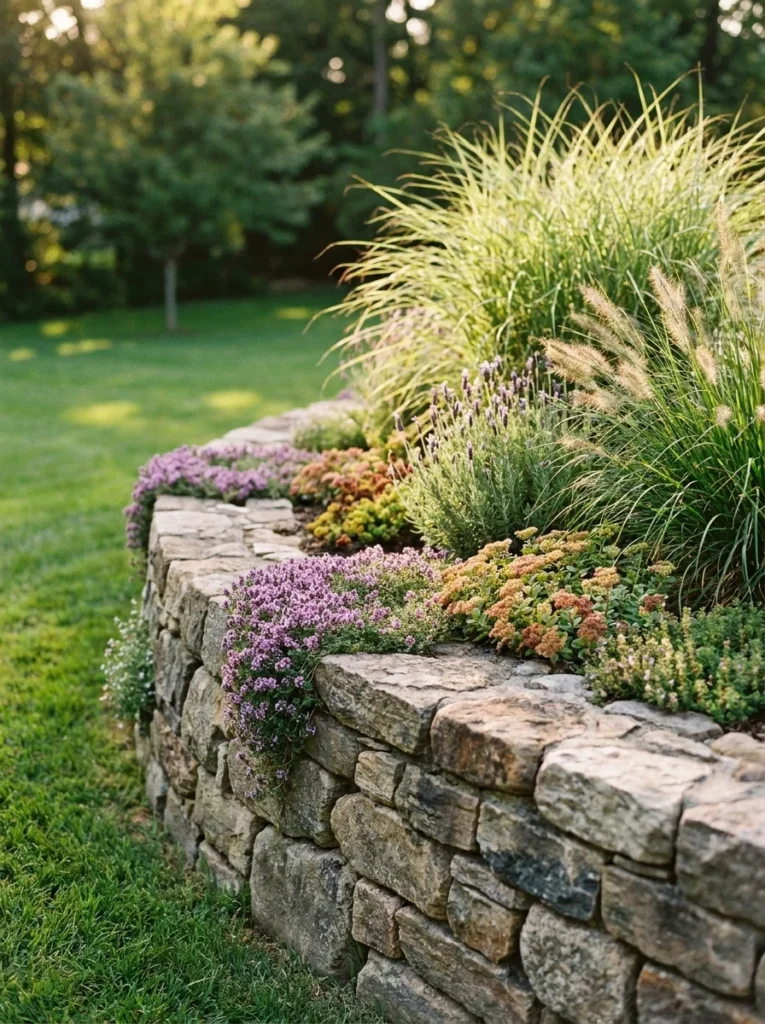
- Creeping thyme — spills beautifully over stones, drought-tolerant
- Sedums — practically indestructible, colorful
- Ornamental grasses — movement, texture, and erosion control
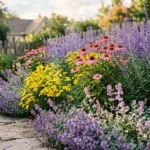
- Black-eyed Susans and coneflowers — bright, native, attract pollinators
- Lavender — fragrant, drought-hardy, gorgeous against gray stone
- Ferns — for shaded walls, they tuck into crevices perfectly
- Creeping phlox — cascades over the top in spring with a riot of color
If you’re thinking about going beyond the wall and transforming the whole yard, check out this excellent guide: How to Replace Your Lawn with a Stunning Edible Landscape (2026 Guide). It’s a fantastic companion to any retaining wall project.
And if you want to add even more personality to your planting scheme, heliotropes are a stunner near stone walls — How to Grow and Care for Heliotropes | Planting, Pruning & Bloom Tips has everything you need to know.
12. How Long Does a Natural Stone Retaining Wall Last?
Here’s one of the best things about natural stone: built correctly, a natural rock retaining wall can last 50 to 100+ years. Dry-stone walls in England and New England have survived hundreds of years with minimal maintenance.
The enemies of longevity are:
- Poor drainage (water damage, freeze-thaw cracking)
- Tree roots pushing through the base
- Skipping the batter (no lean back into the hill)
- Using the wrong stone (soft sandstone, shale)
Maintenance is minimal — occasional re-setting of shifted stones, clearing debris from drainage paths, and keeping aggressive roots away.
13. Can a Retaining Wall Also Be Decorative?
Absolutely — and this is honestly where I think most people underestimate the opportunity. A natural stone wall isn’t just a functional structure. It’s a design feature.
Retaining wall ideas that double as eye candy:
- Tiered walls with planting beds between each level — like a layered garden stage
- Curved walls that flow with the natural contour of the yard
- Integrated seating — cap a lower wall at bench height (18″) and you have built-in seating
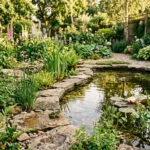
- Water features — a small recirculating fountain tucked into a stone wall is magical
- Night lighting — solar or low-voltage uplighting tucked between stones looks incredible after dark
A landscape retaining wall that doubles as a design focal point? That’s working smarter, not harder.
Want to keep your garden beautiful and critter-free? While you’re planning the plantings around your wall, don’t miss The Best Plants That Keep Spiders Away Effortlessly — a handy guide for keeping the area pleasant.
Conclusion: Build It Right, Build It Once
A natural rock retaining wall is one of those rare home improvements that checks every box — functional, durable, beautiful, and timeless. It solves a real problem (erosion, slope instability, grade changes) while adding genuine character to your outdoor space.
The keys? Good stone, proper drainage, a solid base, and patience. Don’t rush the base prep. Don’t skip the gravel backfill. And don’t build higher than your skill level — there’s no shame in calling a pro for a serious slope.
Now get out there and start stacking.
Have questions about your specific slope or stone choice? Drop them in the comments — I’d love to help you figure out your perfect wall.
Frequently Asked Questions
What is a natural rock retaining wall?
A natural rock retaining wall is a structure built from unprocessed stone — fieldstone, granite, limestone, or boulders — used to hold back soil on a slope and prevent erosion. It can be dry-stacked (no mortar) or mortared.
What stones are best for retaining walls?
Granite, fieldstone, and limestone are the top choices. Granite is the most durable; fieldstone gives the most natural look. Avoid soft sandstone and shale in freeze-thaw climates.
Do natural rock retaining walls need drainage?
Yes — drainage is critical. Use gravel backfill, a perforated drain pipe at the base, and/or weep holes to prevent hydrostatic pressure buildup.
How deep should the base be for a rock retaining wall?
Bury at least 10–15% of the total wall height below grade. For a 3-foot wall, that’s roughly 4–6 inches underground on a compacted gravel base.
How tall can a natural stone retaining wall be?
DIY dry-stone walls should stay under 3 feet. Professional walls with engineered drainage and footings can reach 6 feet or more.
How much does a natural rock retaining wall cost?
DIY materials for a small wall run $200–$800. Professional installation ranges from $1,500 for a small garden wall up to $25,000+ for a large boulder installation.
Do you need a permit for a retaining wall?
In most U.S. areas, yes — for walls over 3–4 feet. Always check with your local building department before starting.
How long does a natural stone retaining wall last?
With proper construction and drainage, 50–100+ years. Dry-stone walls built with good technique are extraordinarily durable.








3 thoughts on “Natural Rock Retaining Wall: The Complete Guide to Building One That Lasts (and Looks Amazing)”